
If you’ve started exploring franchise ownership, you may have already discovered something: franchising has a language all its own.
FDD. Royalty. Territory. Validation. Discovery Day.
At first, it can feel like everyone else in the room received a vocabulary list that somehow missed your inbox.
We understand that feeling.
When we first stepped into franchising, we had plenty to learn too. And over the years, both as franchise owners and now as franchise consultants, we’ve seen how much more confident people become once they understand what these terms actually mean.
You don’t need to become a franchise attorney or memorize every page of an FDD before exploring ownership. But you do need enough knowledge to ask good questions, recognize what deserves a closer look, and make an informed decision.
So let’s translate some of the language you’re likely to hear along the way.
Franchisor and Franchisee: Start With the Relationship
The franchisor is the company that owns the brand and has developed the business system.
The franchisee is the independent business owner who receives the right to operate using that brand, system, processes, and trademarks according to the franchise agreement.
That distinction matters.
When you buy a franchise, you aren’t becoming an employee of the franchisor. You are becoming a business owner operating within an established system.
That means there is both independence and accountability.
The franchisor typically provides things like training, systems, brand standards, operational guidance, marketing resources, technology, and ongoing support. The franchisee is responsible for building and operating the local business while following the standards of the system.
That relationship is one of the first things we encourage prospective owners to evaluate.
You’re not simply choosing a business concept.
You’re choosing a long-term business relationship.
Franchise Agreement: The Contract Behind the Relationship
The franchise agreement is the legal contract between you and the franchisor.
It spells out the rights and responsibilities of both parties, including how long the franchise term lasts, what fees you’ll pay, how the business must operate, what happens at renewal, and under what circumstances the agreement may be transferred or terminated.
This is not a document to skim.
We always encourage prospective franchise owners to work with a qualified franchise attorney who can help them understand exactly what they are agreeing to before signing.
The goal isn’t to make the process frightening. It’s to make sure you’re entering it with your eyes open.
FDD: Your Due-Diligence Road Map
One of the most important terms you’ll hear is FDD, short for Franchise Disclosure Document.
Think of the FDD as a structured look under the hood of the franchise system.
It contains detailed information about the franchise, including fees, estimated startup costs, litigation history, training, territory, franchisee responsibilities, financial information, and details about current and former franchisees.
Prospective franchisees are generally given a required review period before signing an agreement or paying money to the franchisor.
That time exists for a reason.
The FDD isn’t something you’re supposed to rush through. It is a due-diligence tool designed to help you slow down, ask questions, compare what you’ve heard with what is actually disclosed, and understand the opportunity more clearly.
A good franchise investigation involves much more than asking, “Do I like this brand?”
It involves asking, “Do I understand this business?”
What Will It Really Take to Get Started?
One of the first financial questions most prospective owners ask is, “How much does this franchise cost?”
That’s an important question, but it needs a little more context.
The initial franchise fee is not the same thing as the total initial investment.
Depending on the concept, your total investment might include the franchise fee as well as equipment, leasehold improvements, technology, signage, inventory, insurance, training expenses, deposits, opening marketing, professional fees, and working capital.
We encourage clients to look beyond the headline franchise fee.
The better question is, “What capital will I realistically need to get this business launched and give it room to operate?”
That is a much more useful conversation.
Financial Performance Representations
As you investigate a franchise, you may come across a Financial Performance Representation, sometimes called an FPR.
This is where a franchisor may provide information about sales, revenue, profitability, or other measures of financial performance within the franchise system.
Not every franchisor provides this information.
When financial performance information is provided, it can be useful—but it is not a crystal ball.
Historical results from other franchisees don’t tell you exactly what your future business will produce. Markets vary. Owners vary. Expenses vary. Execution varies.
We look at financial performance information as one piece of a much larger investigation.
The question isn’t simply, “How much can I make?”
It’s, “What do these numbers tell me about the business, and what additional questions should I be asking?”
That’s a very different mindset.
Validation: Talk to the People Living It
Numbers matter. So do conversations.
Validation is the part of the process where you speak with existing franchise owners and learn what operating the business is actually like.
You can ask what their first year looked like. What surprised them? How effective was the training? What does franchisor support look like after opening? How long did it take to build a team? What would they do differently? Does the business match what they expected when they invested?
We believe these conversations are incredibly valuable because you’re moving beyond presentations and documents and hearing from people who are living the model every day.
Don’t use validation simply to ask, “Are you happy?”
Dig deeper.
You are trying to understand whether the reality of ownership matches the life and business you are trying to build.
Franchise Fee, Royalties and Other Ongoing Fees
The initial franchise fee is typically the upfront amount you pay for the right to join the franchise system.
But that’s only one part of the financial structure.
Most franchise systems also have an ongoing royalty, which may be calculated as a percentage of gross sales, a fixed amount, or another formula established by the franchisor.
You may also encounter contributions to a national or systemwide brand fund, local marketing requirements, technology charges, software costs, training costs, required supplier expenses, or other ongoing fees.
Our advice is simple: don’t just ask what the franchise costs to buy.
Ask what it costs to operate.
Understanding the full economic picture is part of responsible due diligence.
Liquidity and Net Worth
As you investigate franchises, you’ll often hear two financial terms: liquidity and net worth.
Your net worth generally reflects what you own minus what you owe.
Liquidity refers to assets that are readily available or can reasonably be converted to cash.
Franchisors often establish financial qualifications because they want prospective franchisees to have enough financial capacity to launch and support the business.
This isn’t simply about whether you can write the franchise-fee check.
One of the questions we explore with clients early in the process is whether an opportunity makes sense within their overall financial picture.
Finding an exciting business that doesn’t fit your financial reality isn’t finding the right business.
Territory: Where Can You Do Business?
Your territory defines the geographic area associated with your franchise rights.
But don’t assume that the word “territory” always means the same thing.
Some territories are protected. Some provide different levels of exclusivity. Some business models rely heavily on geographic boundaries, while others may define markets in different ways.
Territory can affect customer acquisition, expansion possibilities, competition within the brand, and the long-term value of your business.
This is another example of why understanding the language isn’t enough.
You also need to understand what that language means in the specific agreement sitting in front of you.
Owner-Operator, Manager-Run and “Semi-Absentee”
Not every franchise requires the owner to play the same role.
Some concepts are designed for an owner-operator who is actively involved in the business day to day.
Others may support a manager-run structure, where the owner hires someone to oversee daily operations while remaining responsible for leadership, financial performance, people, and strategy.
You may also hear the phrase semi-absentee used in franchise conversations.
Whatever label is used, we encourage people to look beyond it.
There really isn’t a substitute for understanding what ownership requires.
How many hours do successful owners actually spend on the business? What responsibilities can realistically be delegated? When can a manager be hired? What does the franchisor expect from the owner?
If your goal is greater flexibility, that’s important.
But flexibility should come from choosing a business model that fits your life and then building the right team and systems—not from assuming business ownership will be passive.
Gross Sales Are Not the Same as Profit
Here’s a distinction every prospective owner needs to understand.
Gross sales, or gross revenue, represents the money coming into the business before expenses.
That is not the same thing as profit.
A business can produce impressive top-line revenue and still have weak economics if labor, rent, materials, royalties, advertising, debt service, or other operating expenses consume too much of that revenue.
So when you’re reviewing financial information, don’t stop at the biggest number on the page.
Learn how the business makes money.
Ask about margins. Ask about labor. Ask about recurring expenses. Ask current franchisees about the costs that surprised them. Build your own financial projections and have qualified professionals help you evaluate them.
Revenue may get attention.
The economics underneath it are what matter.
Discovery Day: A Two-Way Evaluation
Toward the end of a franchise investigation, many brands invite candidates to a Discovery Day, sometimes called a Meet the Team Day or something similar.
This is typically an opportunity to spend more time with the franchisor’s leadership and support team and deepen your understanding of the organization.
Discovery Day can feel exciting. By this point, you may have spent several weeks researching the brand and getting to know the people involved.
But we think there’s an important way to approach it.
It should be a two-way evaluation.
The franchisor is deciding whether you fit their system.
You should be deciding whether they fit you.
Pay attention to the people in the room. Ask yourself whether you trust them, whether their values align with yours, whether their answers remain consistent with what you’ve learned throughout the process, and whether you can picture yourself working alongside this team for years to come.
The goal isn’t to get swept up in the excitement.
The goal is clarity.
Renewal, Transfer and Exit
Most people naturally focus on getting into a franchise.
Smart buyers also think about what happens later.
What happens at the end of your franchise term? What is required to renew? What if you eventually want to sell the business? Does the franchisor have approval rights over a buyer? Are there transfer fees? What happens if the relationship isn’t working?
These are important questions to understand before signing an agreement.
You don’t have to know today exactly how or when you’ll eventually exit the business.
But you should understand the rules before you enter it.
Due Diligence: Perhaps the Most Important Term of All
If there is one phrase we wish every prospective franchisee would take seriously, it is due diligence.
Due diligence isn’t one document, one conversation, or one spreadsheet.
It’s the process of gathering enough information to make a thoughtful decision.
That means studying the FDD. Understanding the franchise agreement. Speaking with franchisees. Evaluating the financial model. Learning about the franchisor’s leadership and support. Considering your territory. Talking with a franchise attorney and other qualified professionals. And, perhaps most importantly, being clear about what you want the business to do for your life.
There is no prize for making the fastest decision.
The goal is to make a well-informed one.
Learning the Language Gives You Better Questions
You don’t need to walk into your first franchise conversation knowing every acronym and industry term.
That’s part of what the exploration process is for.
But as your understanding grows, something important happens: your questions get better.
Instead of asking, “Is this a good franchise?” you begin asking:
“Is this franchise a good fit for me?”
That is the question we care about.
Because the brand everyone else is talking about may not be the right brand for your goals, financial situation, skills, desired role, family, or vision for the future.
Our job at Franchise Together isn’t to push you toward a particular franchise.
It’s to help you understand yourself, understand the opportunities in front of you, and work through a structured process so you can make a decision with greater clarity.
We help clients move through self-discovery, franchise modeling, personalized brand matching, due diligence, validation conversations, Discovery Day, and ultimately the decision of whether or not to move forward.
And our consulting services are provided at no cost to you. We’re compensated by the franchisor if you ultimately choose a franchise, are approved, and move forward.
If you’re wondering whether franchise ownership might fit the next chapter of your life, you don’t need to figure it all out by yourself.
Let’s talk about what you’re looking for, what questions you have, and whether franchising deserves a place in your story.
Schedule a free, no-obligation conversation with us at Franchise Together.
Let’s explore what’s right for you—from start to success.
How We Help You Get Started:
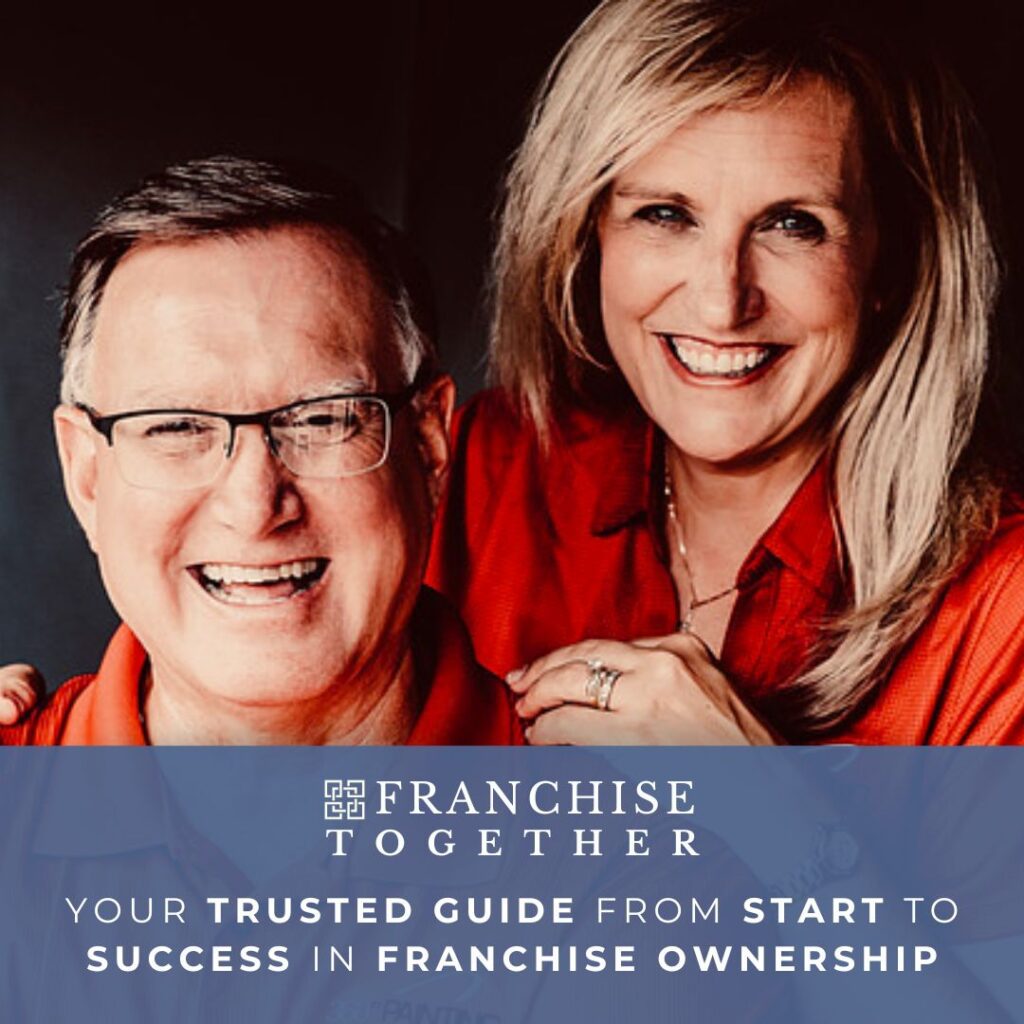
At Franchise Together, we help aspiring entrepreneurs and professionals confidently explore franchise ownership. Through personalized guidance, education, and curated opportunities, we support you in finding a business that aligns with your goals, lifestyle, and financial vision.
Why Work With Us:
As a husband-and-wife team, we combine real-world franchise ownership experience with a passion for helping others succeed. We’ve been in your shoes navigating decisions, evaluating opportunities, and building businesses so we understand both the challenges and the possibilities. Our approach is hands-on, relationship-driven, and focused on helping you make informed, confident decisions.
Our Proven Process:
We take the time to understand your goals, background, strengths, and ideal lifestyle. From there, we guide you through a structured discovery process—introducing you to pre-screened franchise opportunities that match your vision and provide a realistic path to long-term success. Our role is to simplify the journey and give you clarity every step of the way.
Expert Guidance At No Cost To You:
Our services are free to you. We’re compensated by franchise partners for connecting them with qualified candidates, so you get expert guidance, insights, and support without paying out of pocket.
The Next Right Step:
If you’re curious about exploring franchising as a career pivot, investment vehicle or lucrative side hustle, let’s talk! You can book a free no obligation call with Mack or a free no obligation call with Sharon.