
By Sharon and Mack Strange | Franchise Together
You’ve been thinking about business ownership for a while now. Maybe you’re ready for a change in your career. Maybe you want more control over your schedule, more time with family, or the opportunity to build something of your own.
You’ve started exploring franchising, and you’re beginning to see how the right business model might fit into the life you want to create.
Then comes the question that stops a lot of people in their tracks:
“How am I going to pay for it?”
We hear this concern from people exploring franchise ownership, and it’s a reasonable question. Buying a franchise is a significant financial decision. You should understand what you’re committing to, what your options are, and how those decisions could affect your financial future.
Here’s something we want you to know: You don’t necessarily have to fund an entire franchise investment out of your savings.
There are several ways to finance a franchise. The important thing isn’t simply figuring out how to get the money. It’s understanding which financing approach makes sense for your financial circumstances, your comfort with risk, and the life you’re hoping to build.
Let’s walk through some of the options.
First, Understand What You’re Actually Paying For
Before we talk about financing, let’s address something we believe is often overlooked.
The cost of buying a franchise is not necessarily the same as the cost of getting that business up and running.
Depending on the franchise, your initial investment may include the franchise fee, equipment, supplies, technology, training expenses, real estate or leasehold improvements, marketing, insurance, and other startup expenses.
Then there’s working capital.
Working capital is the money you need to cover business expenses while you’re getting established, especially before the business generates enough revenue to support its operations.
This is an important part of financial planning that deserves just as much attention as the initial franchise investment.
When Sharon and I work with prospective franchise owners, we’re not just looking at whether someone can afford to open a business. We’re also thinking about whether the investment and ongoing financial responsibilities align with their goals and resources.
Because owning a business should be a thoughtful decision, not a financial guessing game.
Option 1: Using Your Own Savings
Some prospective franchise owners have accumulated enough cash or other accessible assets to cover all or part of their investment.
There’s an obvious advantage to using cash: You can reduce or eliminate the need for loan payments and interest.
But there’s another side to consider.
What happens if you put a substantial portion of your available savings into the business? Will you still have an emergency fund? Can you comfortably cover your household expenses? Will you have enough financial flexibility if the business takes longer than expected to become profitable?
These are questions worth asking before committing your money.
Using cash may be a good option for some people, while others might prefer to preserve some of their savings and finance a portion of the investment.
Neither approach is automatically right or wrong.
What matters is making a decision with a clear understanding of the trade-offs.
And if you’re not financially ready today, that’s okay, too. You can use this time to strengthen your savings, improve your credit, learn about franchise ownership, and develop a plan.
Sometimes the smartest next step isn’t buying a business. It’s preparing yourself to make that investment when the time is right.
Option 2: Traditional Bank Loans and Lines of Credit
Banks and credit unions are another possible source of franchise financing.
Depending on the lender and the business, you may qualify for a term loan or a business line of credit.
Lenders generally evaluate factors such as your credit history, financial resources, proposed business plan, available collateral, and ability to repay the loan.
A traditional loan can allow you to preserve some of your personal cash while spreading financing costs over time.
However, borrowing money also introduces an obligation that doesn’t disappear when business is slow.
You’ll need to understand your monthly payments, interest rate, repayment terms, collateral requirements, and any personal guarantees.
A personal guarantee is particularly important because it may make you personally responsible for repaying the debt even if the business cannot.
We encourage people to look beyond whether they qualify for financing and ask a more important question:
“Does this level of debt make sense for me and my family?”
Just because a lender is willing to provide financing doesn’t necessarily mean you should borrow the maximum amount available.
Option 3: SBA Loans
One financing avenue worth exploring is a loan backed by the U.S. Small Business Administration, commonly known as the SBA.
The SBA doesn’t typically lend money directly to people buying franchises. Instead, it works with approved lenders and provides guarantees on qualifying loans, which can help lenders manage some of the risk.
Two programs you may encounter are the SBA 7(a) program and the SBA 504 program.
SBA 7(a) Loans
The SBA 7(a) program can potentially help eligible borrowers finance a variety of business needs, including startup expenses, equipment, working capital, and certain real estate costs.
Because the program offers flexibility in how eligible funds may be used, it’s often worth discussing with a lender familiar with franchise businesses.
SBA 504 Loans
The SBA 504 program focuses primarily on eligible long-term fixed assets, such as commercial real estate and certain major equipment purchases.
It isn’t designed to cover every type of startup expense, so its usefulness will depend on the franchise business you’re considering.
SBA financing still comes with qualification requirements, documentation, possible collateral or guarantees, and repayment obligations. The franchise and borrower must meet applicable program requirements.
We encourage prospective owners to speak with experienced SBA lenders early in their investigation rather than assuming they’ll automatically qualify.
For current program details, visit SBA.gov.
Option 4: Using Retirement Funds Through a ROBS Arrangement
This is an option that sometimes surprises people.
Depending on your circumstances, you may be able to use eligible retirement funds to capitalize a new business through a structure known as a Rollover as Business Startups, or ROBS.
A properly structured ROBS arrangement generally involves a new corporation and qualified retirement plan that invests in the business.
One potential attraction is that the arrangement may allow eligible retirement funds to be used without an immediate taxable distribution or early withdrawal penalty when all applicable requirements are met.
However, this is not a simple retirement account withdrawal, and it is not without significant risk.
You’re putting money that was intended for your retirement into a business that may or may not succeed. There are also important tax, retirement-plan compliance, and administrative requirements.
This is an area where qualified professional guidance is essential.
We strongly encourage anyone considering a ROBS arrangement to speak with experienced tax, legal, and retirement-plan professionals before making a decision.
Your retirement security deserves careful consideration.
Option 5: Financing Through the Franchisor
Some franchise companies offer financing assistance or have relationships with third-party lenders.
Depending on the franchise system, that assistance might involve equipment financing, financing for certain startup expenses, or referrals to lending institutions familiar with the brand.
Availability and terms vary from one franchise to another.
One advantage of working with lenders familiar with a particular franchise system is that they may already understand its business model, startup requirements, and operating structure.
But remember, familiarity with a franchise brand doesn’t eliminate the financial risks associated with ownership.
During the franchise investigation process, we help our clients understand which questions to ask about financing, startup costs, and ongoing financial obligations.
And those conversations are part of a much bigger picture: determining whether the franchise is truly a good fit.
Option 6: Bringing in a Business Partner or Investor
Sometimes franchise ownership becomes a possibility through a partnership.
You may know someone who shares your interest in business ownership or has financial resources they’d like to invest.
A partnership can allow two or more people to share the capital requirements, responsibilities, and risks of operating a business.
But there’s more to a successful partnership than putting money together.
You need to understand how decisions will be made, who will manage daily operations, how profits and losses will be allocated, and what happens if one partner wants to leave.
We also encourage partners to talk openly about expectations before they enter a business relationship.
Are you both looking for the same thing? Do you agree about the amount of time and effort the business will require? What happens when you disagree?
These conversations may feel uncomfortable, but having them early can help prevent much bigger problems later.
A qualified attorney should help you document the arrangement, and the franchisor will need to approve any ownership structure required under its agreements.
Option 7: Home Equity Financing
Some prospective franchise owners consider using the equity they’ve built in their homes through a home equity loan or home equity line of credit.
Depending on the lender, this can provide access to capital that may be used toward a franchise investment.
However, we want to be especially clear about the risk.
When you borrow against your home, you’re putting your home at risk if you cannot repay the debt.
That is not a decision to take lightly.
Before using home equity, it’s important to carefully evaluate your household financial picture, repayment obligations, and ability to withstand unexpected business challenges.
The goal is not simply to find capital. It’s to choose a funding approach that allows you to move forward responsibly.
What About Credit Cards and Online Lenders?
Credit cards and online lenders may also provide access to business financing, but their costs and terms deserve close attention.
Interest rates, fees, repayment schedules, and personal guarantees can vary considerably. Some forms of financing may be especially expensive for a new business that hasn’t yet established consistent cash flow.
Before relying on these options, compare the full cost of borrowing and understand how repayment will affect your business.
We generally encourage prospective owners to evaluate more structured financing alternatives before considering high-cost debt.
The Most Important Question Isn’t How Much You Can Borrow
Here’s where we want to shift the conversation.
When someone comes to us interested in franchise ownership, we don’t begin by asking how much money they can borrow.
We want to understand the person behind the investment.
What has you thinking about business ownership in the first place? Are you looking for a different career? More control over your schedule? An opportunity to work alongside your spouse? A business you can build over time?
What does financial security mean to you? How much risk are you comfortable taking? How involved do you want to be in daily operations?
These questions matter because two people with similar financial resources may have very different goals.
One might be comfortable making a larger investment and working full-time in the business. Another may prefer a lower initial investment or a business model designed to operate with a manager.
The right franchise and the right financing structure should support your goals, not work against them.
The best investment isn’t necessarily the biggest one you can afford. It’s one that makes sense for the life you’re trying to create.
Do Your Homework Before You Make a Commitment
One of the reasons we’re so passionate about franchise education is that we know what it feels like to stand where you are.
Before we became franchise consultants, we were the ones exploring business ownership and trying to figure out what our next chapter could look like.
Mack had spent decades in ministry, and Sharon had a background in education and raising our four children. We knew we wanted a different kind of future, but we also knew we needed to make a thoughtful decision.
Working with a franchise consultant helped us evaluate opportunities through the lens of our goals, abilities, and financial circumstances.
That experience changed how we approached business ownership and eventually inspired us to help others navigate the same process.
Today, when we walk alongside someone who’s considering franchising, we encourage them to take their time and investigate thoroughly.
That means reviewing the Franchise Disclosure Document, talking with existing franchise owners, understanding the franchisor’s training and support, evaluating startup and ongoing costs, and discussing financing with qualified professionals.
Those conversations help replace assumptions with information.
And information leads to better decisions.
You Don’t Have to Figure This Out Alone
If you’ve been thinking about franchise ownership but aren’t sure how the financial side would work, we’d love to have a conversation.
At Franchise Together, we help people explore franchise opportunities based on their experience, interests, investment considerations, and personal goals.
We don’t believe in pushing someone toward an opportunity simply because it’s available.
We believe in finding the right fit.
Through our personalized process, we help you clarify your priorities, explore franchise business models, evaluate potential brands, and work through the due diligence process.
We can also help you identify important financing questions and appropriate resources as you investigate your options.
And our consulting services are completely free to you, with no obligation. If you ultimately invest in a franchise through our process, we’re compensated by the franchisor.
You don’t have to arrive with all the answers. You just have to be willing to ask good questions and explore what’s possible.
Maybe franchise ownership is the right next chapter for you. Maybe the timing isn’t quite right. Either way, our goal is to help you make a decision you’ll feel good about.
Because business ownership is about more than buying a business. It’s about the future you’re building and the people who matter most along the way.
Financial information in this article is educational and is not individualized financial, tax, or legal advice. Financing availability, eligibility, and terms vary. Consult qualified professionals before making investment or financing decisions.
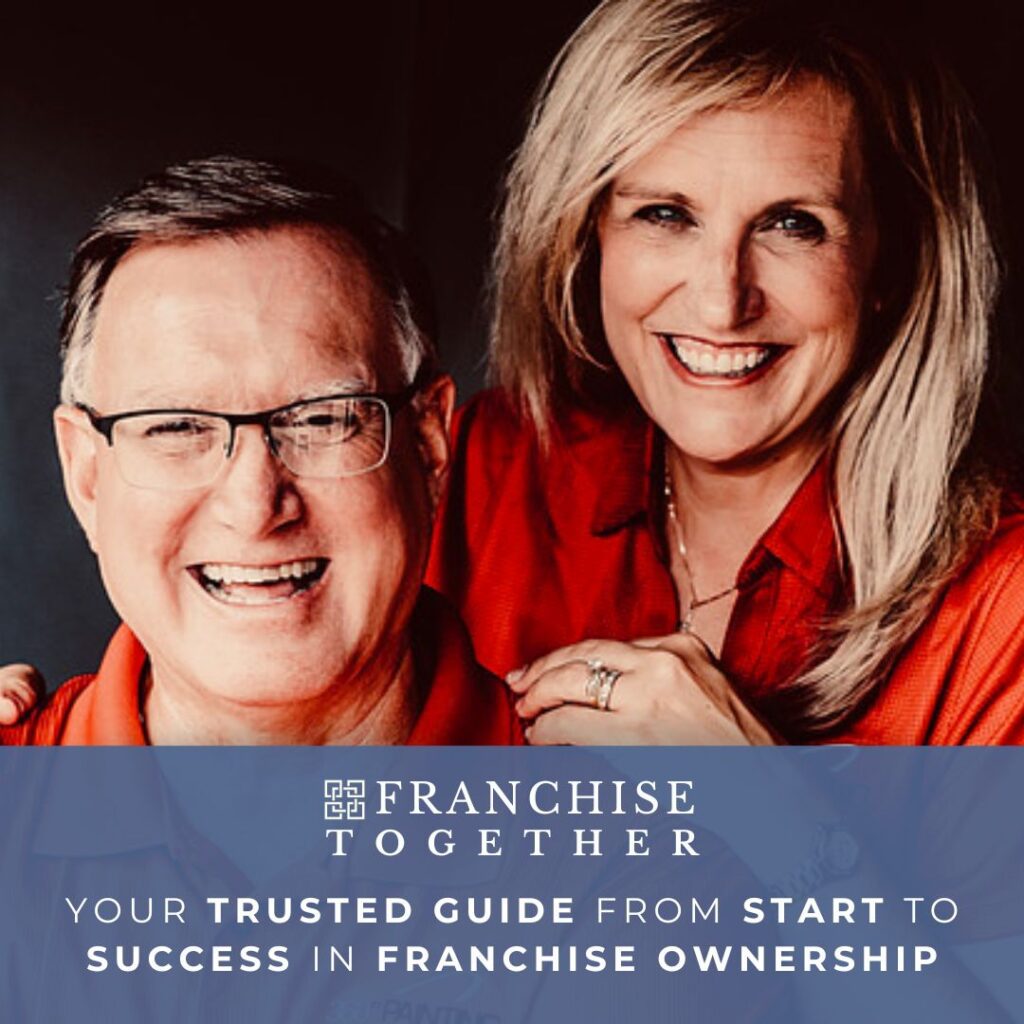
How We Help You Get Started:
At Franchise Together, we help aspiring entrepreneurs and professionals confidently explore franchise ownership. Through personalized guidance, education, and curated opportunities, we support you in finding a business that aligns with your goals, lifestyle, and financial vision.
Why Work With Us:
As a husband-and-wife team, we combine real-world franchise ownership experience with a passion for helping others succeed. We’ve been in your shoes navigating decisions, evaluating opportunities, and building businesses so we understand both the challenges and the possibilities. Our approach is hands-on, relationship-driven, and focused on helping you make informed, confident decisions.
Our Proven Process:
We take the time to understand your goals, background, strengths, and ideal lifestyle. From there, we guide you through a structured discovery process—introducing you to pre-screened franchise opportunities that match your vision and provide a realistic path to long-term success. Our role is to simplify the journey and give you clarity every step of the way.
Expert Guidance At No Cost To You:
Our services are free to you. We’re compensated by franchise partners for connecting them with qualified candidates, so you get expert guidance, insights, and support without paying out of pocket.
The Next Right Step:
If you’re curious about exploring franchising as a career pivot, investment vehicle or lucrative side hustle, let’s talk! You can book a free no obligation call with Mack or a free no obligation call with Sharon.